


Two different backflow tests
Your fire sprinkler backflow gets tested by the water department every year under Ohio EPA rule 3745-95-06. That test uses a differential gauge on the test cocks to prove the check valves hold and the device stops water from flowing backward into the city main. It protects the drinking water.
It says nothing about whether the device lets enough water through, in the right direction, when there is a fire.
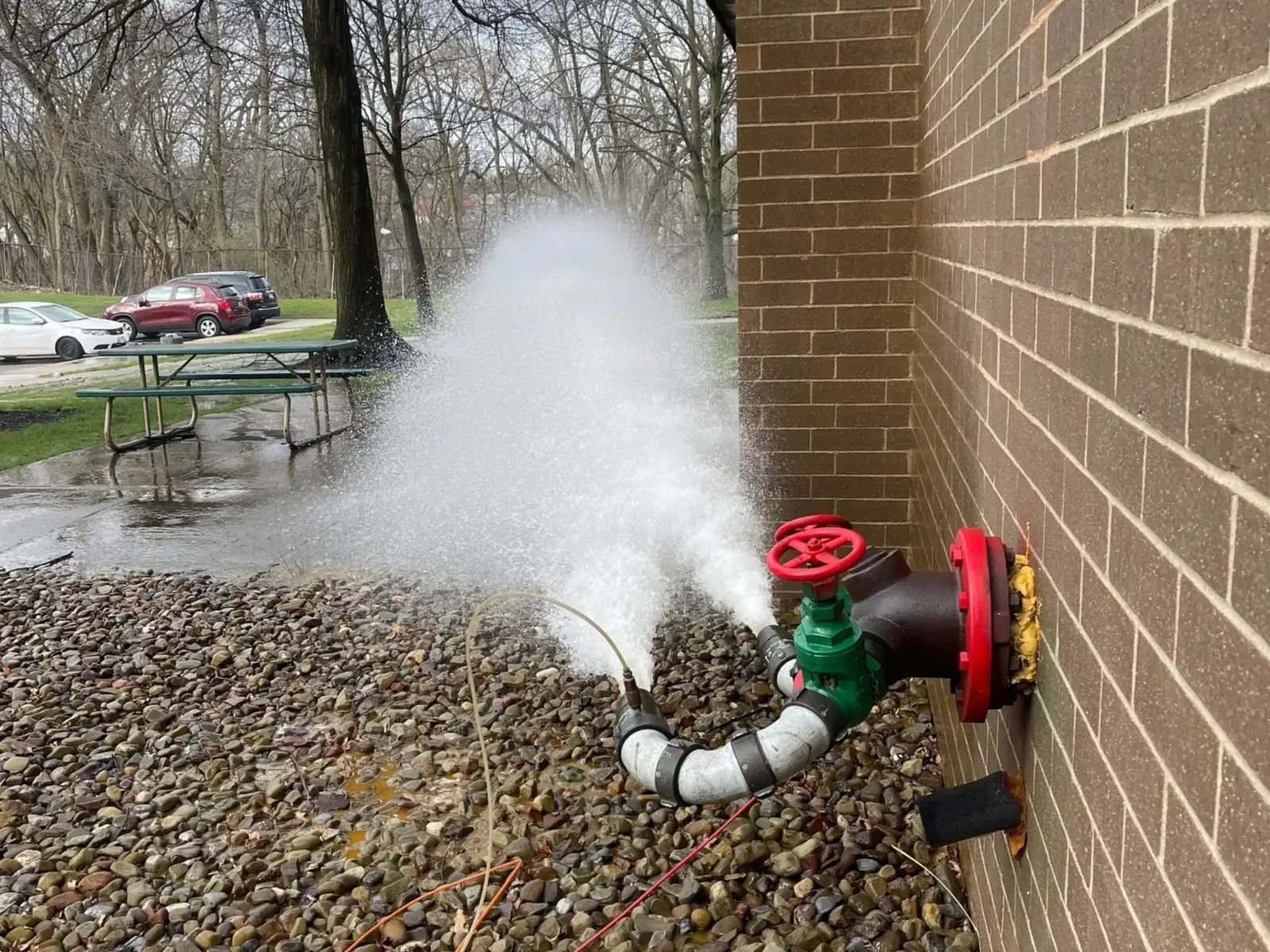
That is the forward flow test. It flows water through the assembly the normal way, at the rate the sprinkler system was designed to need, and proves the checks open fully and the assembly is not strangling the supply. That one protects the building, not the water main. The two tests have different purposes and different standards, and often different people do them. Passing one tells you nothing about the other.
If you are reading this because a fire inspector or a contractor brought it up, you are not behind. A lot of the buildings we walk into have never had one.
What NFPA 25 requires
The Ohio Fire Code, effective November 20, 2025, adopts NFPA 25, 2023 edition, for water-based fire protection systems in its referenced standards table at OAC 1301:7-7-09, section 901.6.1. NFPA 25 chapter 13 covers valves and backflow assemblies, and section 13.7.2 covers the forward flow test. In plain terms it requires three things.
- Every backflow preventer in fire protection piping is exercised annually with a forward flow test at a minimum flow rate equal to the system demand.
- Where hydrants or inside hose stations are downstream of the backflow, the test flow includes the hose stream demand.
- Where the connections do not permit flowing the full demand, the test is conducted at the maximum flow rate possible.
That is the whole requirement, and it fits on an index card.
NFPA 25 also requires the fire line backflow to be opened and internally inspected every five years. The full text of NFPA 25 is on NFPA’s site with free read-only access.
A forward flow requirement has been in NFPA 25 in some form since the 1990s. A fire inspector citing it is enforcing a standard your building has been subject to for a long time, not a new regulation. What has changed is how often it gets asked about. Jared Brown, our owner, in October 2026.
“The Ohio State Fire Marshal is now starting to crack down on getting the GPM and pitot pressures after the backflow, because backflows restrict water supply and they were starting to restrict the hydraulics of the sprinkler systems.”
That is what Jared is seeing on jobs and in plan reviews. We have not found a written bulletin from the State Fire Marshal on it, so take it as field experience from a crew that is in riser rooms every week, not as a quote from a rule.
Why a backflow can starve a sprinkler system
Two things go wrong inside a backflow assembly that never flows.
The checks stick. A double check or RPZ on a fire line sits closed for years, and a check valve that has sat closed for years has its own opinion about opening. Sprinkler systems do not use water until there is a fire, so the check valves never move. Springs take a set, discs stick to seats, debris settles. When the system finally demands water, a check that should swing wide open may only crack. The water department’s test cannot catch this because it only asks whether the check holds, not whether it opens.
The friction loss was never in the calculation. Every sprinkler system has a hydraulic calculation that starts from the city supply and subtracts the pressure lost through every pipe, fitting and valve until the water reaches the most remote heads. A backflow assembly costs several psi at system demand. On a system that was designed and calculated without one, because the device went in later to satisfy the water department, that loss comes straight out of the safety margin. If the margin was thin, or the city pressure has dropped over the decades, the far sprinklers may no longer meet their design flow.
Nobody knows which situation a building is in until the water is actually flowed and measured.
How the test is done

- We pull the system demand from the hydraulic calculation placard on the riser, including hose allowance if hydrants or hose stations are downstream of the device.
- We notify the fire department and the alarm company, because the waterflow alarm is going to trip.
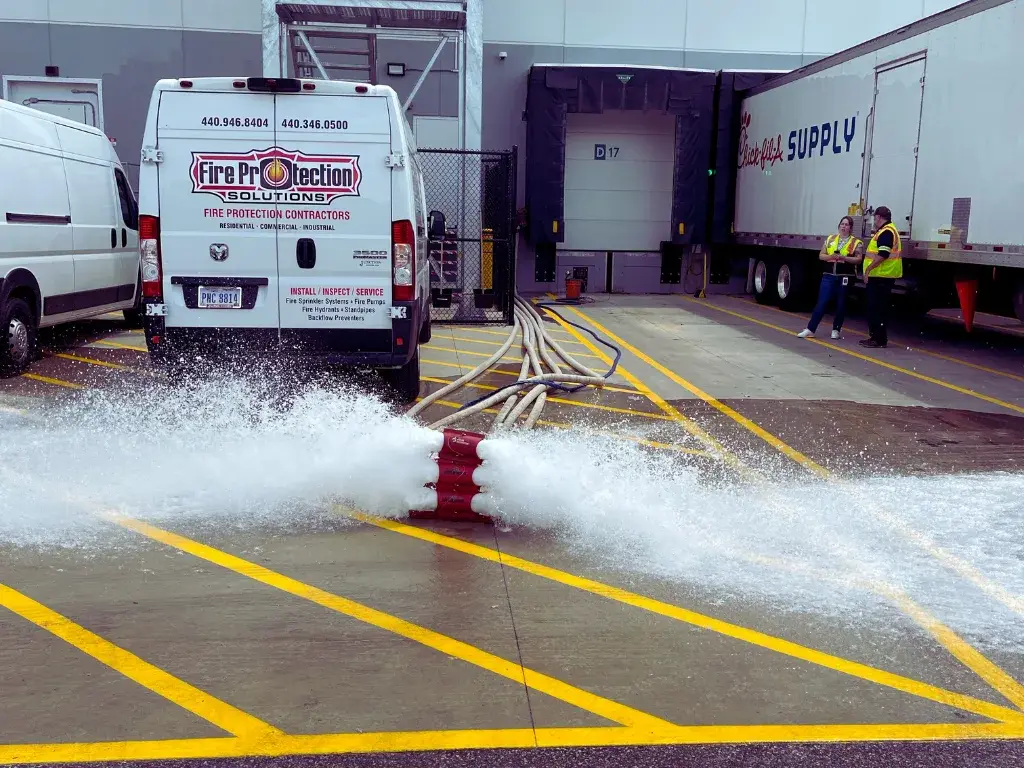
- We open the two and a half inch outlets on the test header downstream of the backflow, enough of them to reach the demand, each fitted with a smooth bore nozzle.
- A pitot gauge goes in each stream to read velocity pressure. Standard hydraulic tables convert nozzle size and pitot pressure into gallons per minute.
- We record static pressure before the flow, residual pressure at the riser during the flow, the pitot readings, and the total GPM.
- The total is compared to the system demand. If it meets or exceeds demand with pressure to spare, the device passes. If it does not, we look at whether the checks are hanging up, whether the supply has dropped, or whether the calculation needs to be revisited.
NFPA 25 does not require the flow to be measured, only that the demand be flowed. We measure it anyway and put the numbers on the report, because a GPM figure is the only way you, your insurer and the fire inspector can see what the backflow and the supply are actually doing. The static and residual pressures also give you a year over year record of your city supply, which is worth having on its own.
The test takes under an hour once we are set up and dumps a lot of water, so we plan the discharge path with you ahead of time. Pick a day the parking lot can get wet.
The forward flow test manifold
A forward flow test needs somewhere to flow. NFPA 13, the sprinkler installation standard, requires a test connection downstream of every backflow preventer so the forward flow test required by NFPA 13 and NFPA 25 can be performed at system demand. The 2022 edition sizes it at one two and a half inch hose valve for every 250 gpm of demand. That connection is what the trade calls a forward flow test header or test manifold.
On a new sprinkler system it is drawn in from day one. The problem is the older Northeast Ohio buildings where a backflow was added years after the system was built, by a plumber satisfying the water department, with no thought to how anyone would ever flow it. Those systems have a device that can only be tested backward.
That is why fire departments are asking for the manifold on new installs. Jared’s description of the job.
“Fire departments are now requesting that since they’re installing the backflow preventer, they have to install a forward flow test manifold so that you can hook 2 1/2 inch fire hoses up to the water supply and get the GPM it’s putting out after the backflow.”
Where there is no header, NFPA 25 allows other ways to flow the demand.
- The fire pump test header, where the backflow sits on the pump suction or discharge and the annual pump test flows through it.
- A yard hydrant downstream of the device on a private fire main.
- Standpipe hose valves on a combined system.
- A bypass around the fire department connection check, arranged per NFPA 13’s annex.
- The main drain, only where it has been upsized enough to pass the demand, which is rare.
Where none of these can pass the full demand, the test is run at the maximum flow possible and noted that way on the report. Where there is no way to flow at all, the honest fix is to install a connection. We do that as part of a backflow installation or as a standalone job on an existing device.
What we do on a forward flow visit
Forward flow testing is part of our fire sprinkler inspection and backflow testing work across Lake, Geauga, Cuyahoga, Ashtabula and the surrounding counties. On a typical visit we do the following.
- Check your records for the last forward flow test and the last five year internal inspection on the fire line device. If there is no record, we assume it has not been done.
- Run the annual forward flow test and record GPM, pitot, static and residual on the report the fire inspector sees.
- Combine it with the water department’s annual backflow test, so the device gets both tests in one visit and both reports get filed.
- Open and inspect the assembly internally on the five year schedule, and rebuild checks that are sticking.
- Design and install a forward flow test header on existing backflows that have no way to flow, or on new installs where the fire department requires one.
- Flag it when the measured flow comes in under the placard demand, and explain what the options are before anyone spends money.
This is the last post in a three part series. Part one covers the backflow notice from your water department. Part two covers installing a backflow when your building has none.
Not sure your backflow has ever had a forward flow test? Call 440-664-3639 or use the form on this page. We will check the records, test it with your annual sprinkler inspection, and give you a GPM number you can hand to the fire inspector.

