

Why so many Northeast Ohio buildings don’t have one
Containment backflow protection on commercial water services has been in Ohio’s rules for decades. Enforcement is what changed. A lot of buildings in Lake, Cuyahoga and Lorain counties went up before the water department checked, and a fire sprinkler service that was installed in the 1970s or 1980s often tied straight into the city main with nothing but a control valve between them.
Nobody noticed until the water department started surveying. Ohio EPA’s 2022 rewrite of OAC 3745-95 requires every water system to investigate all premises on site at least every five years, and that is when the missing devices turn up. Here is how Jared Brown, our owner, described it in October 2026.
“A lot of people throughout Northeast Ohio do not have backflows on their risers or their water services, so we’ve been getting quite a few of those recently through referrals. Inspection, testing and installation of backflow on domestic and fire water supplies.”
Referrals, not ads. The letter lands, the owner calls whoever tested the building down the street.
If you got the notice and found out there is nothing to test, the first post in this series, Got a Backflow Test Notice in Ohio?, covers the letter and the deadline. This one covers the install.
Domestic water and fire water are two different devices
A commercial building usually has two water services. The domestic line feeds sinks, toilets, kitchens and process equipment. The fire line feeds the sprinkler riser and nothing else. Each one needs its own containment device, sized to its own pipe and matched to its own hazard.
Cleveland Water’s Backflow Prevention Policies say the utility “shall determine the type and location of each backflow prevention device on domestic and fire lines based upon degree of hazard.” The domestic device typically goes right after the meter or at the first point of entry. The fire line device has its own placement rules, which we get to below.
A plumber can handle the domestic side. No knock on plumbers, it is a different trade. The fire side is a change to a life safety system. It is sized to the sprinkler demand, it affects the hydraulic calculation, it needs a fire department impairment notice while the system is down, and it needs the forward flow test connection that the fire inspector will look for. That is why our backflow installation work on fire lines is done by sprinkler fitters, not plumbers.
Double check, double check detector, or RPZ
Three assemblies cover almost every commercial job.
A double check valve assembly (DC) is two independent check valves in series, with a shutoff valve on each end and test cocks in between. It is approved for pollutional hazards.
A double check detector assembly (DCDA) is a double check with a small metered bypass that registers low flow, so the water department can tell if someone is drawing water off the fire line or if there is a leak. This is the standard fire line device on a plain wet sprinkler system.
A reduced pressure principle assembly (RP or RPZ) has two checks plus a relief valve between them that dumps water to the floor if either check fails. It is required for health hazards. It needs a drain, and it has to be above ground and protected from freezing.
Ohio’s rule 3745-95-05 sets the tiers. A severe health hazard needs an air gap. A health hazard needs an air gap or an RP assembly. A pollutional hazard may use “an approved double check valve assembly or an approved double check-detector check valve assembly.” For fire systems, the rule requires an RP where health hazards exist, otherwise an RP or a double check.
You do not pick. The water supplier does, and Cleveland Water says so outright, which saves everyone an argument. What pushes a fire line from a double check detector to an RPZ is anything in the sprinkler water that should never reach the drinking water supply. Antifreeze loops, foam systems, corrosion inhibitors, or a connection to a tank, pond or private well all do it.
Inside the building or in a vault at the curb
Cleveland Water’s policy puts the fire line assembly “at the curb stop, in a vault or heated enclosure, or at the first point of entry inside the building.” If the distance from the curb stop to the building entry is under 50 feet, it can go inside. Otherwise “it must be placed in an underground vault or above ground heated enclosure at the curb stop.” RP assemblies “must be installed above ground and protected from freezing,” and “an unprotected bypass around any backflow device is not permitted.”
That 50 foot rule is where the big jobs come from. A building set back from the street, on a 6 or 8 inch fire service, ends up with an 8 inch detector assembly in a precast vault in the lawn or the parking lot. That means excavation, a vault set, a crane or excavator, new pipe on both sides, and a vault lid the water department can open. Jared’s note from the field.
“Some of these are 8 inch backflows in meter vaults.”
Lake County Department of Utilities keeps it simpler on its backflow page. The device goes “at the meter.” Other cities have their own placement rules, and we check them before we draw anything.

What the job looks like
Every install runs the same sequence. The timeline depends on the water department and the permit office more than on us.
- Site survey. We measure the service size, locate the curb stop and the meter, check the riser room access, and read the existing hydraulic calculation if one exists.
- Water department approval. Device type and location submitted to the water supplier. Cleveland Water requires devices from its Approved Backflow Device List.
- Plan review and permit. A new assembly on a sprinkler service is a modification to the fire protection system, so the fire code official reviews it. This is also where the forward flow test connection gets drawn in.
- Impairment notice. The sprinkler system is out of service during the changeover. We file the impairment with the fire department and the building’s alarm company, and we set a fire watch if the authority requires one.
- Install. Cut in the assembly, the control valves, the test cocks, the detector meter if it is a DCDA, and the forward flow test header or hose valves downstream.
- Initial test and report. OAC 3745-95-06 requires a test at installation. We test it, file the report with your water department, tag the device, and hand you the paperwork.
For an indoor fire line assembly with a test connection, the physical work is usually a day or two. Our most recent one was about a day and a half from shutdown to the system back in service. Vault jobs run longer because of the excavation.
A new backflow changes your sprinkler math
This is the part that gets missed when a plumber or a general contractor quotes the fire line.
Every sprinkler system was hydraulically calculated when it was designed. The designer started from the city water supply, subtracted the friction loss through every pipe and fitting, and proved that the most remote sprinklers would still get their design pressure and flow. A backflow assembly is a large fitting with real friction loss, often several psi at system demand. If the original calculation did not include one, because there was no device when the system was built, adding one eats into the margin the designer left.
On a system with plenty of supply, no problem. On an older system that was calculated tight, or a building where the city pressure has dropped since the 1980s, the sprinklers at the far end may no longer meet their design. Nobody knows until the water is flowed and measured.
That is why fire departments want a forward flow test connection on these installs and why NFPA 25 requires an annual forward flow test on every fire line backflow. Jared again.
“Fire departments are now requesting that since they’re installing the backflow preventer, they have to install a forward flow test manifold so that you can hook 2 1/2 inch fire hoses up to the water supply and get the GPM it’s putting out after the backflow, to make sure the backflow isn’t restricting the hydraulic calculations of the sprinkler system.”
The third post in this series, Forward Flow Testing for Fire Sprinkler Backflows, explains the test and the manifold. If a proposal for a fire line backflow does not mention a forward flow test connection, ask why.
What it costs
We are not going to print a price list. Backflow installs range from a 2 inch domestic assembly swapped in a morning to an 8 inch detector assembly in a vault with a crane on site, and a number that fits one is wrong for the other.
What we will say is that the equipment alone is a real cost on the large fire line jobs. Retail list prices for an 8 inch stainless double check detector assembly with OS&Y valves run well into five figures before any labor, excavation, vault or permit. Installs of that size are not an afternoon’s work and should not be priced like one.
If a number lands in your inbox before anyone has stood in your riser room, be suspicious of it.
We quote every install on site. The number includes the device, the pipe changes, the test connection, the initial test and the report filed with your water department. If you already have a quote from a plumber for a fire line device, get a second one from a sprinkler contractor and compare what is included.
After it goes in
The device is yours, under Ohio’s definition of “consumer” in 3745-95-01. From the day it is installed, the recurring work is yours.
The water department test comes around every 12 months under 3745-95-06, done by a certified tester with the report filed. Avon Lake wants the first report within 10 days of a new system’s activation, and other systems have similar windows. Our testing service handles the filing.
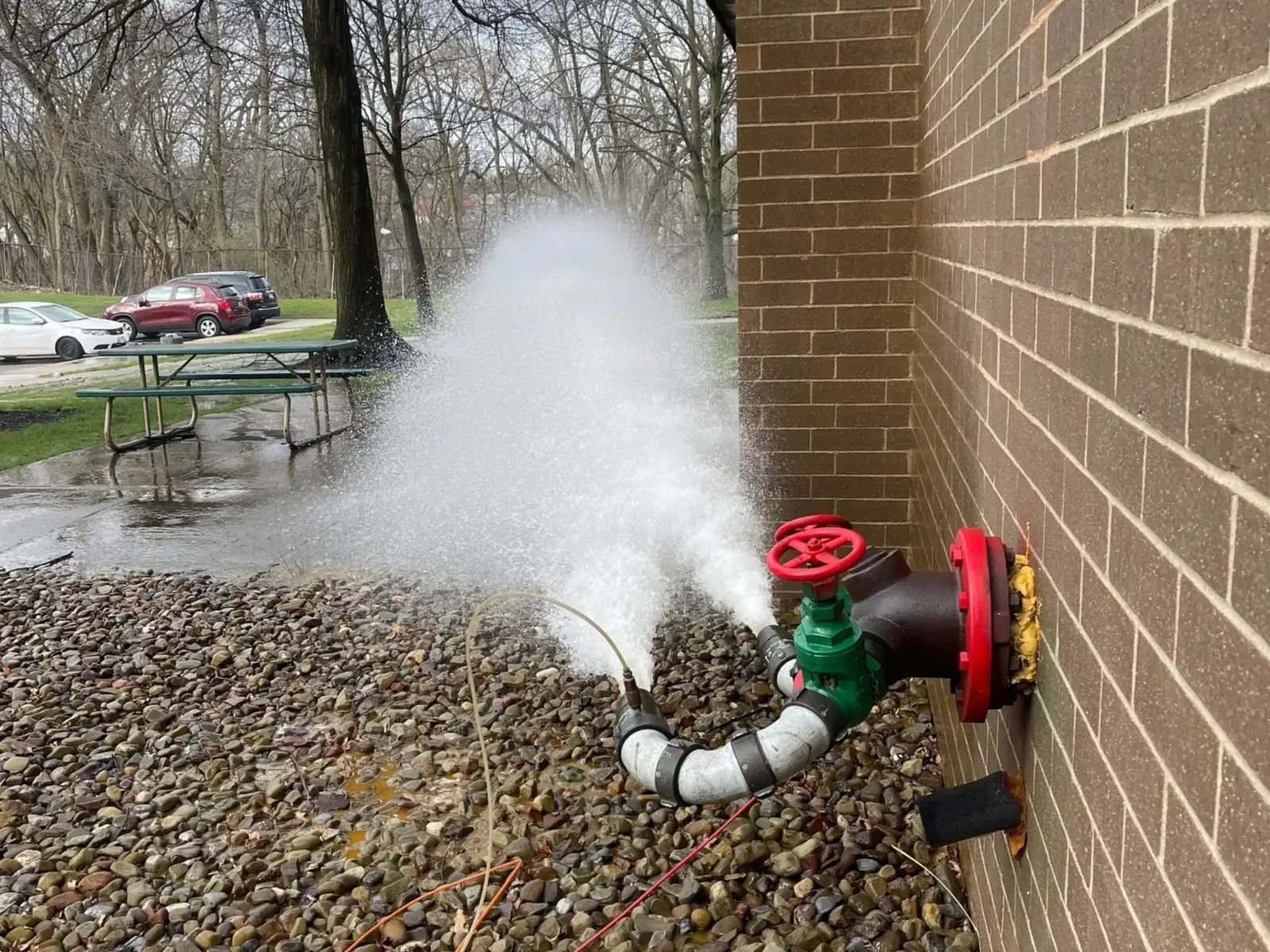
On the fire side, NFPA 25 adds an annual forward flow test, done with the annual sprinkler inspection, and the fire inspector looks for it on the report. NFPA 25 also requires the fire line device to be opened and the checks inspected every five years. The photo at the top of the first post in this series is what that looks like.
One more item for buildings with a fire pump. Under 3745-95-07, a fire pump drawing from the public main needs a low suction throttling valve or variable speed suction limiting control that holds suction pressure at or above 10 psi, and the owner has to certify to the water supplier every 12 months that it works. We cover that on our fire pump service visits.
Got a quote for a new backflow, or a notice saying you need one? Call 440-664-3639 or use the form on this page. One site visit covers the device, the location and the test connection, and the quote you get back is the whole job.